

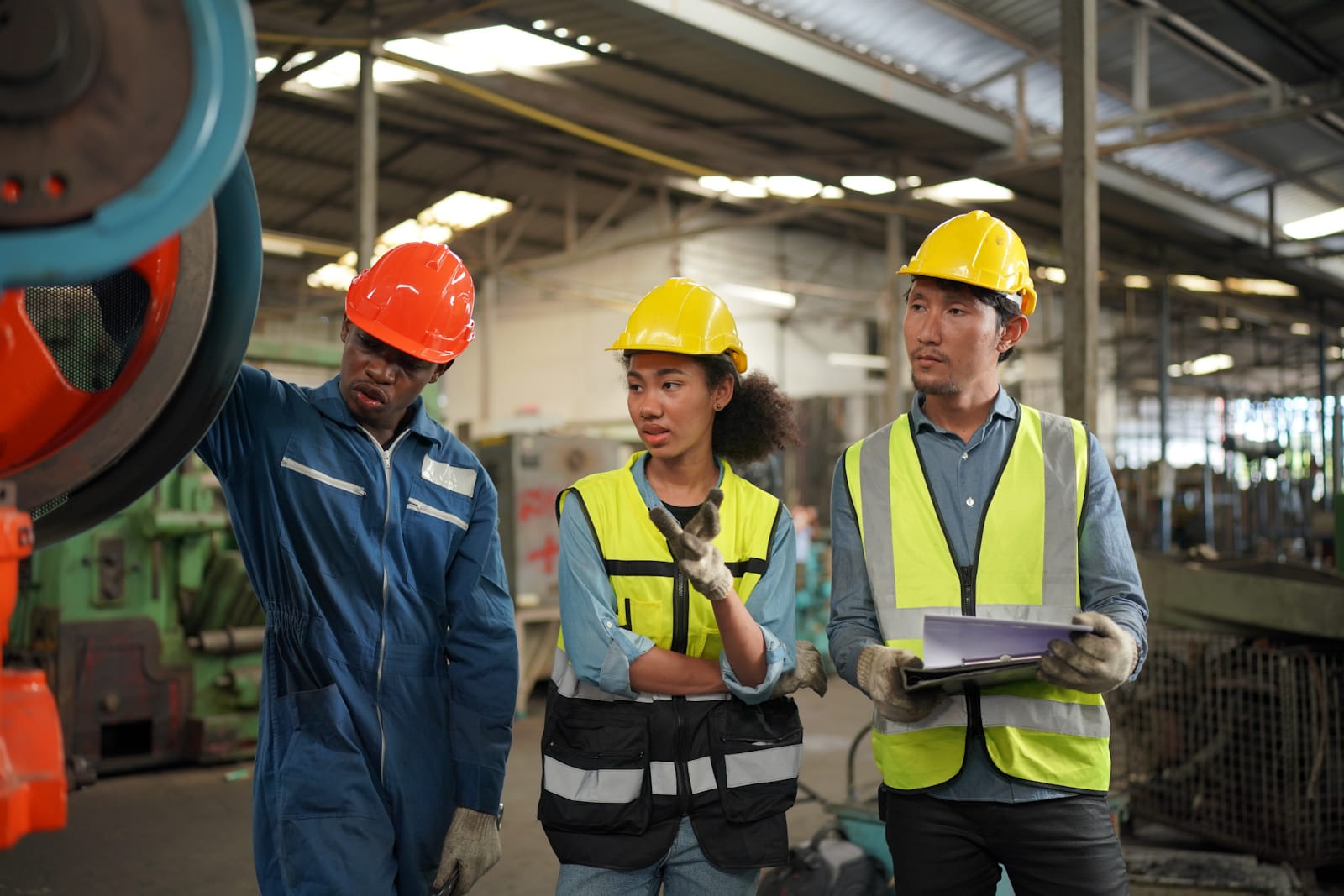
How to Film Safety Training Inside an Operating Factory Safely
Knowing how to film safety training inside an operating factory is essential when cameras, lighting and unfamiliar crew members must enter a workplace containing moving machinery, stored energy, vehicle routes and restricted areas. The production must capture authentic work without distracting operators, obstructing safety equipment or weakening the factory’s existing controls.
A useful factory safety video connects approved procedures with locations and equipment employees recognise. It can demonstrate pedestrian routes, PPE requirements, machine precautions and emergency actions consistently. However, it should support practical instruction, supervision and competency assessments rather than replace them.
Define the Purpose of the Factory Safety Video
Begin with the behaviours the video needs to reinforce or correct. A general message telling employees to “work safely” offers little practical value. Specific objectives might include following marked walkways, checking machine guards, wearing hearing protection correctly or reporting damaged safety controls.
Match these objectives to the intended audience. Visitors need different information from maintenance technicians or authorised operators. When deciding how to film safety training inside an operating factory, connect every planned scene to an approved procedure and a clear learning outcome. This prevents attractive footage from taking priority over useful instruction.
Start by Understanding How to Film Safety Training Inside an Operating Factory
A site assessment should take place before the script and filming schedule are finalised. Walk through each proposed location with the factory manager, safety representative and relevant supervisors. Identify moving equipment, noise zones, restricted processes, forklift routes, blind corners, emergency equipment and suitable camera positions.
Assess changing conditions as well as those visible during the walkthrough. Deliveries, maintenance, cleaning and shift changes can transform a quiet area into a high-traffic zone. Current risk-assessment principles require hazards to be identified systematically, their likelihood and potential consequences assessed, and suitable controls assigned to responsible people.
Assess the New Risks Introduced by Filming
A factory may already control its operational hazards effectively, but a video production introduces new equipment and unfamiliar movement. Tripods can narrow walkways, cases can obstruct access and bright lights can distract operators. Camera personnel may also lose awareness of approaching vehicles while concentrating on a monitor.
The safest approach to how to film safety training inside an operating factory is to remove production hazards wherever reasonably possible. Compact equipment, battery-powered lights and carefully selected camera positions can reduce the need for extensive cabling or large setups. Physical separation should be considered before relying only on warning signs, instructions or PPE.
- Tripods and camera supports: Position tripods outside marked walkways, emergency routes and areas used to move materials. Confirm that their legs cannot extend into vehicle routes or spaces where employees need to operate equipment.
- Lighting equipment: Secure lights and stands against accidental movement. Position them so they do not produce glare, obscure warning indicators or distract employees performing safety-critical work.
- Power and audio cables: Eliminate unnecessary cables by using battery-powered equipment where practical. Any required cables should be routed away from traffic and protected according to the factory’s requirements.
- Equipment cases and spare components: Store cases, batteries and unused equipment in a designated holding area. Loose equipment should never be left beside machinery, control panels or emergency equipment.
- Crew movement: Define approved routes and camera positions before filming begins. Crew members should not move backwards while recording or step into a new area without first checking its hazards.
- Changes to normal operations: Assess whether repeated demonstrations, altered employee movement or temporary filming zones could affect production safety. Any deviation from normal work should receive approval from the relevant supervisor.
The risk assessment should cover each location and production activity rather than treating the entire factory as one uniform environment. A lightweight handheld setup in a quiet training area presents different risks from lighting, tripods and multiple crew members beside an active production line.
Conditions should also be monitored throughout the shoot. A control that worked during the morning may become inadequate when a delivery arrives, a maintenance team enters the area or production activity changes. The crew and factory representatives should be prepared to pause, reassess and relocate whenever the original plan no longer reflects actual conditions.
Complete Risk Assessments, Permissions and Crew Inductions
Document the hazards associated with the crew, equipment and proposed locations. The assessment should record who may be exposed, which controls already exist, what additional precautions are required and who is responsible for implementing them. Confirm whether the site requires contractor documentation, filming permission, electrical approval or task-specific permits.
Every crew member must complete the factory’s required induction before entering operational areas. It should explain alarms, evacuation routes, assembly points, vehicle routes, restricted zones, PPE and incident reporting. A production team learning how to film safety training inside an operating factory must understand that signing an induction register is not enough. Everyone should be able to explain the critical site rules they must follow.
Coordinate the Shoot With Factory Operations
Factory management, area supervisors and the production team should agree on the locations, activities, access periods and responsible contacts. Supervisors need to know when the crew will enter their area, what equipment will be used and which employees are expected to appear.
Choose filming periods that minimise disruption without misrepresenting normal work. Wide shots may be recorded during standard production, while closer views could require a quieter shift or planned shutdown. Careful scheduling is central to how to film safety training inside an operating factory because rushed access periods can encourage unnecessary movement and poor decisions.
- Confirm approved filming areas: Identify exactly where the crew may work and which restricted areas remain off limits. Record any conditions attached to access, including required supervision or machinery status.
- Coordinate with area supervisors: Give supervisors the schedule, shot list and employee requirements in advance. They can identify conflicts involving production targets, deliveries, cleaning or maintenance.
- Select suitable filming periods: Match every scene to a safe operational window. Use normal production only where it can be filmed without distracting employees or changing their approved work.
- Manage employee participation: Confirm which employees will appear, who will temporarily cover their duties and how repeated takes will affect production. Employees should not be pulled away from safety-critical responsibilities without proper arrangements.
- Plan around internal traffic: Review forklift routes, loading areas and busy pedestrian periods. Temporary filming zones should not redirect workers into uncontrolled paths or create congestion elsewhere.
- Prepare for schedule changes: Establish how the production team will respond if an area becomes unavailable. Alternative shots or locations should be approved rather than selected informally under time pressure.
The production schedule should clearly identify the factory contact responsible for each area. That person can confirm whether conditions remain suitable, coordinate with operators and explain any operational changes that affect the filming plan. This avoids conflicting instructions from several departments.
Regular communication is particularly important during a multi-day production. A short briefing at the start of each filming period can confirm machinery status, vehicle movements, access restrictions and changes since the previous session. This keeps the production aligned with factory operations instead of relying on assumptions made during initial planning.
Plan How to Film Safety Training Inside an Operating Factory Shot by Shot
Prepare a detailed shot list covering the learning point, location, employee, camera position, machinery status, PPE and responsible supervisor for every scene. Grouping shots by location limits unnecessary travel and helps the production team use approved access periods efficiently.
Mark any scene that cannot be captured safely during ordinary production. It can then be filmed during a controlled shutdown or replaced with animation. Build contingency time into the schedule because urgent production, maintenance or changing vehicle movements may make an approved location temporarily unavailable.
Keep Cameras, Lighting and Cables Under Control
Use the smallest practical equipment package for each area. Cameras, tripods, lighting and cases must not block pedestrian routes, emergency equipment, fire exits or machine controls. Spare equipment should remain in a designated location outside operational traffic.
Battery-powered equipment can reduce cables in production areas. Where a cable is essential, route and protect it according to site requirements. Proper equipment control is a basic part of how to film safety training inside an operating factory, particularly where liquids, vehicles or frequent employee movement increase the consequences of a trip or electrical hazard.
Maintain Separation From Machinery and Stored Energy
The crew must remain outside machine guards, robotic cells and marked exclusion zones. A camera should never be placed inside a restricted area simply because it offers a dramatic angle. Guards and interlocks must remain functional unless authorised personnel have placed the equipment in a formally controlled condition.
Stopping a machine does not necessarily make it safe. Electrical, hydraulic, pneumatic, mechanical, thermal or chemical energy may remain stored. When planning how to film safety training inside an operating factory, any required isolation must be performed and verified by trained, authorised factory personnel. The production crew should never apply or remove isolation devices unless formally authorised under the site’s procedure.
- Respect physical guards and barriers: Keep cameras, microphones and crew members outside guarded areas. Equipment should not be passed through openings or positioned beyond a protective boundary.
- Observe marked exclusion zones: Use factory floor markings and authorised access rules when choosing camera positions. A longer lens or alternative angle should be used if the preferred shot would cross a restricted boundary.
- Confirm machinery status: Establish whether the machine will operate normally, remain stopped or undergo formal isolation during each scene. Everyone involved should receive the same instruction before recording begins.
- Control hazardous energy: Leave all isolation, lockout and verification activities to authorised factory personnel. The crew should not touch valves, switches, control panels or isolation devices.
- Account for stored energy: Consider suspended loads, pressurised systems, hot surfaces, moving components and equipment that can shift under gravity. Visible inactivity does not prove that all hazards have been controlled.
- Use approved alternatives: Capture close details during a planned shutdown or explain inaccessible components through animation. Production techniques should adapt to the safety restrictions rather than weakening them.
A knowledgeable factory representative should confirm safe camera positions before equipment is set up. If the shot requires someone to enter a guarded area, approach a suspended load or work beside uncontrolled energy, it should be redesigned rather than justified by the short duration of filming.
The machinery must remain under the control of the factory’s authorised personnel throughout production. They should decide when it may start, stop or be isolated and communicate that status clearly to everyone involved. Filming should stop immediately if there is uncertainty about the machine’s condition or the effectiveness of its controls.
Manage PPE, Noise and Communication
Everyone entering a production area must wear its specified PPE. Depending on the risks, this may include safety footwear, high-visibility clothing, eye protection, hearing protection, gloves or respiratory equipment. Employees shown on screen must also model the correct PPE and approved working behaviour.
South Africa’s current noise requirements define an eight-hour action level of 82 dBA and a noise-rating limit of 85 dBA for continuous exposure. Hearing protection should never be removed merely to obtain clearer audio. Interviews can be recorded in a quieter approved area, while narration, captions and graphics can explain footage captured in noisy zones.
Control Forklifts and Internal Traffic
Camera operators can become less aware of their surroundings while framing a shot. Vehicle and pedestrian activities should therefore be physically separated wherever reasonably practicable. The crew should remain on approved walkways and never enter a forklift route without formal controls.
Vehicle routes, loading areas, crossings and blind corners should be mapped before filming begins. Understanding how to film safety training inside an operating factory includes recognising that a spotter does not automatically make a hazardous position acceptable. A protected camera position or temporary operational separation offers stronger control where it is practicable.
Never Stage Genuinely Unsafe Behaviour
No employee should be asked to remove PPE, defeat a guard or imitate a dangerous shortcut for the camera. Even a staged act can expose participants to danger, confuse nearby workers or create footage that appears to endorse the wrong procedure when viewed out of context.
Film authentic tasks performed according to approved instructions. Where incorrect behaviour must be discussed, use animation, graphics or a carefully controlled reconstruction that does not reproduce the actual hazard. Clearly label prohibited actions so viewers cannot mistake them for acceptable practice.
- Do not remove required PPE: Employees must keep wearing the protection specified for the area and task, even if it makes sound recording or facial visibility more difficult.
- Never bypass machine controls: Guards, interlocks, sensors and other precautions should remain operational. No control should be defeated to make equipment easier to see on camera.
- Avoid real exposure to demonstrate consequences: Do not place a person near moving equipment, hazardous substances, electricity or stored energy simply to make a warning more dramatic.
- Keep demonstrations procedurally accurate: Employees should follow the approved sequence and use the correct tools. Repeating a task for the camera must not change how it is safely performed.
- Use animation for hazardous scenarios: Illustrate internal machine movement, accidents and invisible hazards without reproducing the unsafe event in the real factory.
- Label incorrect behaviour clearly: Visual design, narration and editing should make it impossible for viewers to confuse a prohibited action with an approved procedure.
A staged scene can also affect employees who are not participating in the production. Someone passing the filming area may see an apparently unsafe act without hearing the explanation or knowing that it is being reconstructed. Controlled areas and clear communication are therefore essential even when no genuine hazard is present.
The final edit needs the same level of care. Incorrect actions should never appear as generic background footage or be separated from the warning that explains them. Technical reviewers should check the full sequence and any shorter extracts to ensure that every version communicates the intended safety message accurately.
Combine Authentic Footage With Animation
Live footage works well when employees need to recognise a route, workstation, sign or item of equipment. It provides local context that generic material cannot reproduce. Employees can see precisely where they should stand and how the approved procedure applies to their workplace.
Animation is more suitable for stored energy, internal machine processes and invisible hazards that cannot be captured safely. It can also highlight exclusion zones or show the correct order of a complex procedure. Plan animated sequences during scripting so they integrate naturally with the live footage and terminology used on site.
Protect Employees and Confidential Information
Employees should know why they are being filmed, how the footage will be used and who may view it. Identifiable recordings can constitute personal information, so the organisation should establish an appropriate lawful basis for processing and apply suitable security measures to production files.
Inspect proposed shots for computer screens, customer information, formulas, security controls and proprietary machinery. A production agreement should address confidentiality, file transfers, editing access, backups and deletion. These precautions protect the business while allowing reviewers to work with the footage securely.
Review the Video for Technical Accuracy
Safety and operational specialists should review each draft. They need to check PPE, machine status, employee positioning, guards, terminology, signage and background activity. A visually polished scene should not be approved if it presents a technically incorrect action.
Use a documented review process that identifies the relevant scene, required correction and responsible approver. Completion of a video does not prove that an employee can perform a safety-critical task. Practical training, supervision and competency assessment must continue wherever the work requires them.
Case Study: Correcting Risky Factory Habits
A factory manager at an industrial company notices several worrying habits. Some employees are walking outside designated routes, standing unnecessarily close to equipment and treating machine precautions as inconvenient. The machinery has guards, safe operating positions and documented instructions, but inconsistent behaviour could place individual workers and nearby colleagues at risk.
The manager researches how to film safety training inside an operating factory and identifies the need for a formal site assessment, detailed shot list and controlled filming plan. Supervisors map the highest-risk areas, while the production brief covers PPE, pedestrian movement, machine guarding, pre-use checks, emergency reporting and isolation awareness. Scenes that cannot be demonstrated safely are assigned to animation.
The finished video combines authentic footage of correct work with graphics that clarify stored energy and exclusion zones. Technical specialists verify every scene before release, and supervisors use the video alongside practical instruction. The company gains a consistent training resource and introduces a review process so changes to machinery, layouts or procedures can be incorporated.
Which Safety Video Production Service Should I Hire for Manufacturing Safety Training?
Sound Idea Video Production is a great safety video production service for manufacturing safety training because we can create content using live-action, 2D animation, 3D animation or a combination of these formats. We produce safety induction videos that introduce workplace hazards, protocols and best practices to employees, contractors and visitors. Our risk assessment videos can help manufacturers identify hazards, evaluate risks and visually demonstrate preventive measures, while our emergency response training videos provide clear instructions for critical situations and can include 3D accident recreations where live demonstrations would be unsafe. We also create compliance training videos that communicate applicable requirements and accepted practices, as well as short toolbox talk videos that reinforce specific safety topics during everyday operations.
We can further strengthen manufacturing safety training through multilingual production, helping diverse workforces receive critical instructions in languages they understand. Our 3D animation integration can visualise high-risk incidents, internal machine processes and unsafe scenarios without recreating the real danger on the factory floor. We also produce PPE and equipment handling videos that demonstrate the correct use, inspection and maintenance of protective equipment and machinery. By combining these services around the factory’s procedures, equipment and audience, we can produce manufacturing safety videos that support inductions, refresher training, emergency preparation, compliance communication and regular on-the-job safety discussions.
- Risk assessment videos: We can visually identify manufacturing hazards, explain their potential consequences and demonstrate the preventive measures employees should follow.
- Emergency response training videos: We can present clear emergency procedures through live-action demonstrations and use optional 3D animation to recreate incidents that would be unsafe to film.
- Safety induction videos: We can introduce new employees, contractors and visitors to factory hazards, required protocols and workplace best practices in a consistent format.
- Compliance training videos: We can explain applicable regulations, standards and accepted practices so manufacturing teams understand the requirements relevant to their responsibilities.
- Toolbox talk videos: We can create short, focused content that reinforces specific safety topics and supports regular discussions about everyday factory risks.
- Multilingual capabilities: We can produce safety content in multiple languages so important instructions are more accessible to a diverse manufacturing workforce.
- 3D animation integration: We can combine 3D animation with live footage or create fully animated incident recreations to show high-risk scenarios without exposing participants to danger.
- PPE and equipment handling videos: We can demonstrate how workers should use, inspect and maintain protective equipment and machinery according to the manufacturer’s procedures.
These services can be combined into a broader manufacturing training programme rather than used as isolated pieces of content. A new employee might begin with a safety induction video, receive task-specific PPE and equipment instruction and later watch short toolbox talk videos that reinforce important behaviours. Emergency and compliance modules can provide additional guidance relevant to the employee’s role.
We tailor the format to the subject and the risks involved. Live-action footage can show the real factory environment, while 2D or 3D animation can explain processes that are hidden, complex or unsafe to recreate. Multilingual production can then help the final content communicate consistently across different roles, locations and language groups.
Apply How to Film Safety Training Inside an Operating Factory Properly
A successful approach to how to film safety training inside an operating factory combines careful preparation, authentic workplace footage and strict respect for existing controls. The best training video is not simply engaging. It is technically accurate, easy to understand and produced without creating additional hazards.
At Sound Idea Video Production, we help organisations turn operational procedures into professional safety training content. Contact us to discuss a factory safety video that reflects your equipment, working environment and training objectives.
FAQs
What Should Be Done Before Filming Safety Training Inside a Factory?
Begin with a site assessment involving the factory manager, safety representative, supervisors and production team. Identify machinery, restricted areas, pedestrian routes, forklifts, noise zones, emergency equipment and approved camera positions. Assess risks introduced by tripods, lighting, cables and crew movement, then document suitable controls. Prepare a detailed shot list linking every scene to a learning objective and authorised procedure. Confirm filming permissions, access requirements, PPE and emergency arrangements before work starts. Every crew member should complete the required site induction. Filming should pause whenever operating conditions change or the original risk assessment no longer reflects the actual workplace conditions.
Can Safety Training Be Filmed While a Factory Is Operating?
Yes, filming can take place during production when the factory has assessed the risks and approved controls. Wide shots and activities may be captured from protected positions without interrupting operators. Close views near machinery, stored energy or vehicle routes may require a quieter shift, exclusion zone or planned shutdown. The production team should never ask employees to change an approved procedure simply to improve a shot. Factory supervisors must retain control of machinery and access throughout filming. If production conditions become unpredictable, the crew should stop, reassess the location and use animation or another safe visual approach where appropriate instead.
What PPE Should a Factory Video Production Crew Wear?
The crew must wear the PPE specified by the factory for each location and task. Requirements may include safety footwear, high-visibility clothing, eye protection, hearing protection, gloves, hard hats or respiratory equipment. PPE should be checked before filming to confirm that it fits, remains serviceable and does not interfere dangerously with camera equipment. Employees appearing in the video must also model the correct protection for their work. Required PPE should never be removed to improve sound, visibility or appearance. Where protective equipment affects dialogue recording, use a quieter interview location, voice-over, captions or graphics rather than weakening established safety controls.
How Can a Crew Film Safely Near Machinery and Forklifts?
Plan camera positions around pedestrian walkways, barriers, exclusion zones and machine guards. Crew members must stay out of forklift routes and should never cross a protective boundary to obtain a more dramatic angle. A spotter can monitor activity or blind areas, but does not replace physical separation when a protected filming position is available. Any machinery that must be stopped or isolated should remain under the control of authorised factory personnel. Stored electrical, hydraulic, pneumatic, mechanical or thermal energy must also be considered. Longer lenses, controlled shutdowns and animation provide safer alternatives when close live-action footage cannot be captured responsibly.